
Living in Florida means embracing a life of sun, surf, and tropical breezes. However, for many homeowners from Miami to Tallahassee, there is a hidden struggle inside the home: the battle against mineral-heavy water.
Florida’s geological makeup, primarily composed of limestone, ensures that our groundwater is packed with calcium and magnesium. When this water hits your beautiful shower surfaces and evaporates, it leaves behind a stubborn, chalky residue.
Learning how to clean bathroom tiles with hard water Florida is an essential skill for anyone who wants to maintain a high-value, hygienic home in the Sunshine State.
I’ve walked into many stunning Florida homes where the master bath looks aged beyond its years, simply because of “scale creep.” It starts as a faint cloudiness on your porcelain or ceramic tiles and eventually turns into a rock-hard crust that regular soap just can’t touch.
In our 80% humidity, these mineral deposits don’t just sit there; they trap body oils and soap scum, creating a breeding ground for bacteria. This guide is designed to provide you with the exact protocols needed to dissolve these deposits safely.
We will explore the science of Florida’s water and provide a step-by-step roadmap to reclaiming your bathroom’s original luster.
For those managing multiple properties, understanding the apartment cleaning cost in Florida is a great way to see how pros factor in these hard water challenges.
The Florida Hard Water Reality: Why Your Tiles are at Risk
Florida’s water is famously “hard” because it travels through vast underground limestone aquifers. As the water sits in these limestone caves, it dissolves the rock, picking up high concentrations of minerals.
When you shower, that mineral-rich water coats your tiles. In Florida’s warm climate, the water evaporates quickly, but the minerals stay behind, creating “limescale.”
This buildup is particularly aggressive in coastal areas where salt air can further complicate the chemical bond of the minerals. If left untreated, these deposits can “etch” certain types of tile, creating permanent pits that can never be fully smoothed out.
This is why a proactive approach to clean bathroom tiles with hard water Florida is mandatory for long-term home maintenance. To keep the rest of your home as fresh as your tiles, don’t forget to check our mildew smell removal guide.
The “Hard Water Decoded” Toolkit
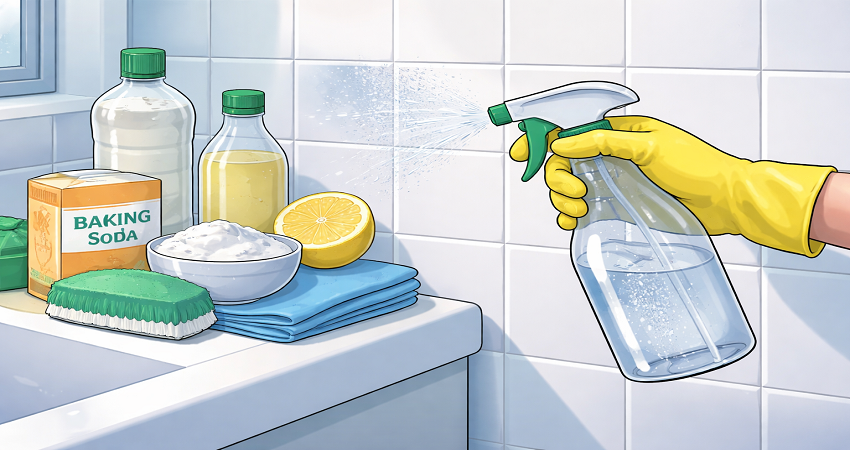
Standard bathroom cleaners often fail against Florida scale because they aren’t acidic enough to break down calcium bonds. You need a specialized toolkit to see real results:
- Distilled White Vinegar: The ultimate mild acid for dissolving mineral clusters.
- Baking Soda (Sodium Bicarbonate): Provides the mechanical “grit” needed for scrubbing without scratching.
- Soft-Bristle Nylon Brush: Essential for reaching deep into the textured surfaces of your tiles and grout.
- Lemon Halves: Naturally high in citric acid, perfect for detailing faucets and tight corners.
- Microfiber Cloths: Crucial for the “final dry” to ensure no new minerals settle back down.
The “Soak & Scrub” Method: A Step-by-Step Protocol
To effectively clean bathroom tiles with hard water Florida, you must give the chemistry time to work. Rushing the process is the most common mistake Florida homeowners make.
1. The Acidic Pre-Soak
Mix a solution of 1 part white vinegar to 1 part water. In Florida, I recommend using heated vinegar for an extra boost in dissolving power. Spray the solution generously over the tiles.
- The Secret: Do not wipe it off immediately. Let it sit for at least 15–20 minutes. You may even hear a faint fizzing—that is the acid winning the battle against the calcium.
2. The Agitation Phase
After the soak, create a paste using baking soda and a small amount of water. Apply this directly to the areas with the heaviest white buildup. Using your nylon brush, scrub in a circular motion. The baking soda reacts with the vinegar remains to lift the loosened minerals from the tile pores.
3. The Freshwater Flush and Dry
Rinse the tiles thoroughly with cool water. This is the most important part: Use a clean microfiber cloth to dry the tiles completely. If you leave them to air-dry in Florida’s humidity, you are simply allowing a fresh layer of minerals to settle back onto the surface.
Regional Hardness: How Your City Affects the Clean
Water hardness isn’t uniform across the state. Depending on your local municipality’s filtration system, your cleaning frequency may need to adjust.
| Florida City | Typical Hardness Level | Recommended Cleaning Frequency |
|---|---|---|
| Miami / South Florida | Very High (Limestone heavy) | Twice Weekly |
| Orlando / Central Florida | High | Once Weekly |
| Tampa / Gulf Coast | Moderate to High | Every 10 Days |
| Jacksonville / North Florida | Moderate | Bi-Weekly |
Handling the “Grout Trap”
Grout is porous, meaning it literally “drinks” hard water. Once the minerals get inside the grout, they can cause it to crack or crumble.
To clean grout lines, use a Hydrogen Peroxide and Baking Soda mixture. This provides an oxygen-bleach effect that lifts stains and kills mold without the harshness of chlorine bleach. For more on keeping your air and surfaces mold-free, see our guide on cleaning air vents in Florida.
The Protective Shield: Post-Cleaning Maintenance
Once you’ve successfully managed to clean bathroom tiles with hard water Florida, the goal is to make the next clean easier.
- Squeegee After Every Use: It takes 30 seconds but prevents 90% of mineral buildup.
- Apply a Tile Sealer: For natural stone tiles (marble/travertine), a high-quality sealer creates a barrier that prevents minerals from penetrating the stone.
- Use an After-Shower Spray: A simple daily mist of water and a tiny bit of tea tree oil can keep the surface slick so water beads off quickly. You can find more eco-friendly recipes in our natural cleaning tips.
Commercial Degreasers Vs. Natural Solutions
Sometimes, if a bathroom hasn’t been cleaned in months, natural vinegar might not be enough. In these cases, look for commercial “Limescale, Calcium, and Rust” (CLR) removers. However, be extremely careful in Florida’s enclosed bathrooms. These fumes can be intense.
Always keep the exhaust fan running and the door open. Generally, we recommend the natural route first to protect your home’s air quality.
- Pro Tip: If your showerhead has poor flow, it’s likely clogged with the same hard water minerals. Tie a plastic bag filled with warm vinegar around the showerhead and let it soak overnight. The minerals will dissolve, and your water pressure will return to normal!
Frequently Asked Questions (FAQ)
1. Can I use bleach on hard water stains?
Actually, bleach is not very effective against mineral deposits. It can kill mold, but it doesn’t dissolve calcium. In some cases, bleach can even make the white mineral stains look more prominent.
2. Will hard water damage my glass shower doors?
Yes. Over time, the minerals can “etch” into the glass, causing permanent cloudiness. Using a squeegee and a vinegar-based cleaner is the best way to prevent this.
3. Is lemon juice safe for all tiles?
Lemon juice is safe for ceramic and porcelain. However, avoid using it on marble, limestone, or travertine, as the acid can “eat” into the soft stone, causing dull spots.
4. Why does the white residue keep coming back so fast?
If you don’t dry the tiles after cleaning, the minerals in the rinse water will simply settle right back down. Drying is the most critical step in the Florida climate.
5. Do water softeners really help?
Absolutely. A whole-home water softener removes the calcium and magnesium before the water ever reaches your shower, making cleaning significantly easier.
Conclusion
Mastering the way to clean bathroom tiles with hard water Florida is one of the most rewarding home maintenance tasks. While the minerals in our water are persistent, they are no match for a consistent, acidic cleaning routine.
By treating your bathroom to a weekly vinegar soak and ensuring surfaces are dried, you can maintain a “spa-like” feel in your home regardless of the local water hardness.
If you find that the buildup has become a mountain you can’t climb alone, consider checking the house cleaning cost in Florida for a professional deep-cleaning service to give you a fresh baseline. Don’t let the limestone win—reclaim your shine today!
Your Next Step: Try the “Vinegar Soak” on one corner of your shower this weekend and see the difference for yourself!