Living on the Florida coast in 2026 offers a lifestyle defined by turquoise waters and rhythmic tides, but it also presents a relentless mechanical challenge for homeowners. The very air that makes coastal living so desirable is saturated with “salt spray”—a fine mist of sodium chloride that acts as a powerful corrosive agent.
To Protect Your Florida Home From Coastal Salt Air Damage, you must understand that salt is hygroscopic, meaning it literally pulls moisture out of the air and holds it against your home’s surfaces, creating a perpetual “wet-rust” cycle.
In our subtropical climate, where humidity rarely drops below 50%, this process is accelerated, leading to structural degradation that can devalue a property by thousands of dollars in just a few seasons. This technical guide provides a roadmap for 2026 homeowners to fortify their properties against the invisible threat of salt air.
I’ve assisted many Florida residents who were shocked to find their “stainless steel” fixtures pitting and rusting within just six months of moving to the coast.
The reality is that “stainless” does not mean “salt-proof.” To truly Protect Your Florida Home From Coastal Salt Air Damage, you need a multi-layered defense strategy that involves material science, chemical barriers, and consistent maintenance.
While you are budgeting for these protective measures, you might also find it useful to check the house cleaning cost in Florida for professional exterior washing services. Below is the 2026 protocol for coastal preservation.
The Chemistry of Coastal Corrosion
Salt air damage isn’t just “dirt.” When salt particles (NaCl) settle on metal, they break down the protective oxide layer that prevents rust. In Florida, this is intensified by our high UV index, which “bakes” the salt into the paint and sealants.
- The 5-Mile Rule: While homes directly on the Atlantic or Gulf are at highest risk, salt air can travel up to 50 miles inland during a major Florida storm. To effectively Protect Your Florida Home From Coastal Salt Air Damage, you must treat your exterior surfaces as if they are constantly under chemical attack. For more on managing the moisture that fuels this corrosion, see our summer cleaning checklist for high humidity.
1. Material Selection: The First Line of Defense
In 2026, the best way to Protect Your Florida Home From Coastal Salt Air Damage is to build or renovate with materials that are naturally “inert” to salt.
- Marine-Grade Stainless (316): Most home stores sell 304-grade steel. For Florida coasts, you must insist on 316-grade, which contains molybdenum to resist chloride corrosion.
- Fiber Cement Siding: Unlike wood (which rots) or vinyl (which can become brittle), fiber cement is exceptionally resilient against salt and humidity.
- Impact-Resistant Glass: Beyond storm safety, modern impact windows feature specialized coatings that prevent “salt etching,” which can permanently cloud standard glass.
For those living in beach-specific environments, refer to our specialized beach house cleaning tips for deeper material insights.
2. The “Fresh Water Flush” Protocol
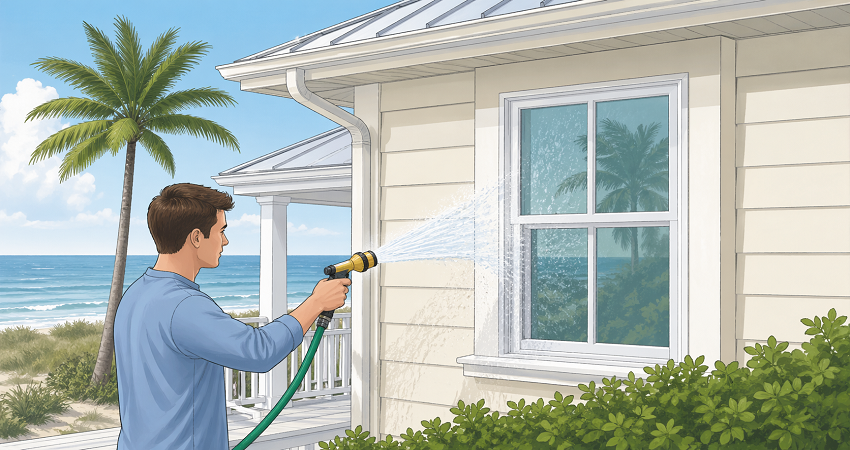
The most cost-effective way to Protect Your Florida Home From Coastal Salt Air Damage is also the simplest: regular rinsing.
- The Monthly Rinse: Use a standard garden hose to rinse your siding, windows, and outdoor AC unit. Do not use a high-pressure power washer, as this can force salt deeper into the pores of wood or masonry. A gentle “flush” removes the salt crystals before they can bond with the surface. This should be a staple in any weekly Florida house cleaning checklist to ensure long-term durability.
2026 Salt-Resistant Material Comparison
| Component | Standard Material | Coastal Recommended | Lifespan Benefit |
|---|---|---|---|
| Exterior Hardware | Zinc/Chrome | PVD Coated or 316 Steel | +10 Years |
| Window Frames | Unfinished Wood | Anodized Aluminum/Vinyl | +15 Years |
| Railings | Wrought Iron | Powder-Coated Aluminum | No Rust Issues |
| HVAC Fins | Standard Copper/Alum | Blygold or Epoxy Coating | +5 Years |
3. AC Maintenance: Preventing “Coil Failure”
Your air conditioner is especially vulnerable because it “breathes” the salt air. To Protect Your Florida Home From Coastal Salt Air Damage, you must protect your condenser coils. Salt buildup on the fins prevents heat exchange, making your unit work harder and eventually causing it to “leak” refrigerant.
- The Solution: Apply an anti-corrosive spray to the coils twice a year. If you are noticing a musty smell or poor airflow, it might be time for a professional clean air vent service to ensure no salt-laden dust has infiltrated your indoor ductwork.
4. Protective Barriers and Sealants
Paint is more than just color; it’s a chemical shield.
- Elastomeric Paint: This thick, flexible coating is ideal for Florida’s stucco homes. It stretches to cover small cracks, preventing salt air from reaching the concrete blocks (which can cause “spalling”).
- Clear Nanocoatings: In 2026, ceramic coatings aren’t just for cars. Applying a ceramic spray to your outdoor light fixtures and handles creates a hydrophobic barrier that salt cannot stick to.
- Sand Management: Sand often carries salt into your porch. Using a DIY sand-repellent floor spray can help keep these corrosive particles away from your threshold.
Pro Tip: Look for “Coastal Grade” labels on all outdoor purchases. If a product doesn’t explicitly mention salt-spray testing (ASTM B117), it likely won’t survive more than two seasons on a Florida beach.
5. The Indoor Invasion: Air Quality
Salt air doesn’t stop at your front door. It enters through “micro-leaks” and settles on your indoor electronics and furniture. To Protect Your Florida Home From Coastal Salt Air Damage internally, focus on air filtration.
High-quality filters can trap salt particles before they settle on your TV or computer components. For a deeper dive into respiratory and electronic health, see our guide on maintaining indoor air quality.
6. Professional Restoration Costs
If your home has already suffered from neglect, you may need a professional “reset.” For properties that were recently built or renovated, the post-construction cleaning cost in Florida often includes specialized salt-removal treatments.
If the damage is deep, such as rusted grout or stained tiles, refer to deep cleaning vs standard cleaning to understand the level of intervention required.
Frequently Asked Questions (FAQ)
1. Can salt air damage my car too?
Absolutely. If your home is coastal, your car is at risk. Always park in a garage when possible and wash your vehicle’s undercarriage frequently to prevent frame rot.
2. Does salt air affect roof shingles?
It affects the nails more than the shingles. Standard roofing nails will rust through, causing shingles to fly off in high winds. Always use stainless steel or hot-dipped galvanized fasteners for coastal Florida roofs.
3. Is there a natural way to clean salt off windows?
A mixture of 1 part vinegar to 4 parts water works well, but for heavy salt crust, you need a specialized “salt-releasing” soap available at marine supply stores.
4. How far inland does salt air reach?
In Florida, you are never more than 60 miles from the coast. While the first 1,500 feet are the “critical zone,” salt air can be detected across the entire peninsula after a hurricane or tropical storm.
5. Why are my light fixtures turning green?
That is “verdigris,” a form of corrosion on copper or brass. While some like the look, it indicates the metal is being eaten away. A thin coat of carnauba wax can slow this down.
Conclusion
In 2026, to Protect Your Florida Home From Coastal Salt Air Damage is to engage in a continuous conversation with the environment. You cannot stop the sea, but you can certainly stop it from claiming your home.
By choosing the right materials, committing to a freshwater rinse schedule, and utilizing modern nanocoatings, you can enjoy the beauty of the Florida coast without the financial burden of constant repairs.
A clean home is a protected home. Whether you are doing the maintenance yourself or hiring a deep cleaning service in Tampa to help, consistency is your greatest ally.
Florida’s sun and salt are powerful, but with the right protocol, your home will remain a pristine sanctuary for decades to come. Happy coastal living!
Your Immediate Action Step: Walk outside today and check your outdoor AC unit. If the metal fins look “dusty” or white, give them a gentle rinse with a hose—it could save you thousands in energy and repair costs!