In the high-traffic environment of a Florida home, the kitchen is more than just a place to cook—it is the heart of the residence. However, because of our unique local climate, kitchen floors often age prematurely. Between the tracking in of fine coastal sand and the humidity that turns kitchen grease into a sticky magnet for dirt, tile grout can quickly turn from a bright white to a muddy grey.
If you are wondering How To Restore Your Kitchen Floors without a major renovation, the answer lies in the gaps between your tiles.
In 2026, you don’t need industrial chemicals or a thousand-dollar professional service to bring back the shine. This guide provides a mechanical, budget-friendly strategy to whiten your grout for less than $10, using simple household chemistry.
I’ve consulted with many homeowners who felt their kitchen was “permanently” dirty despite daily mopping. The reality is that mopping often makes grout worse by pushing dirty water into the porous cement lines.
Understanding How To Restore Your Kitchen Floors starts with a deep-extraction mindset rather than a surface-cleaning one. While you are budgeting for your home improvement, you might also be interested in the house cleaning cost in Florida for professional-grade floor restoration.
However, if you have an hour and ten dollars, you can achieve a “showroom” look today. Below is your step-by-step 2026 restoration blueprint.
The Science of “Sticky” Kitchen Grout
To effectively Restore Your Kitchen Floors, you must understand why grout is so difficult to clean. Grout is a cementitious, porous material. In a kitchen, these pores act like tiny sponges that absorb cooking oils, spilled juices, and the fine dust that blows in through Florida’s ventilation systems.
- The Grease Trap: When you cook, microscopic oil particles settle on the floor. In Florida’s 50%+ indoor humidity, these oils never fully dry, creating a permanent “tack” that captures every bit of dust. This is why standard soap often fails; you aren’t just cleaning dirt, you are degreasing a mineral surface. For a deeper look at the humidity factor, check out our summer cleaning checklist for high humidity.
1. The $10 Restoration Kit: What You Need
In 2026, most of the effective tools for How To Restore Your Kitchen Floors are likely already in your pantry.
- Baking Soda (Sodium Bicarbonate): $1.50 – Acts as a mild abrasive and a natural whitener.
- White Distilled Vinegar: $2.50 – The acid needed to react with the alkaline baking soda and lift stains.
- Hydrogen Peroxide (3%): $1.50 – A natural bleaching agent that kills mold spores.
- Nylon Grout Brush: $4.00 – Necessary for physical agitation of the pores.
Total Cost: $9.50. This kit is significantly more effective than many store-bought “all-purpose” cleaners because it utilizes a carbon-dioxide reaction to physically blast dirt out of the grout lines.
2. The Step-by-Step Restoration Protocol
To Restore Your Kitchen Floors properly, follow this specific mechanical sequence:
Step A: The “Dry-Vac” Extraction
Before introducing any liquids, vacuum the floor twice. In Florida, sand is our biggest enemy. If you add liquid to sand, you create a grinding paste that can scratch your tiles. Using a vacuum with a HEPA filter is best; see our tips on maintaining indoor air quality for why dry-extraction is key.
Step B: The Chemical Reaction
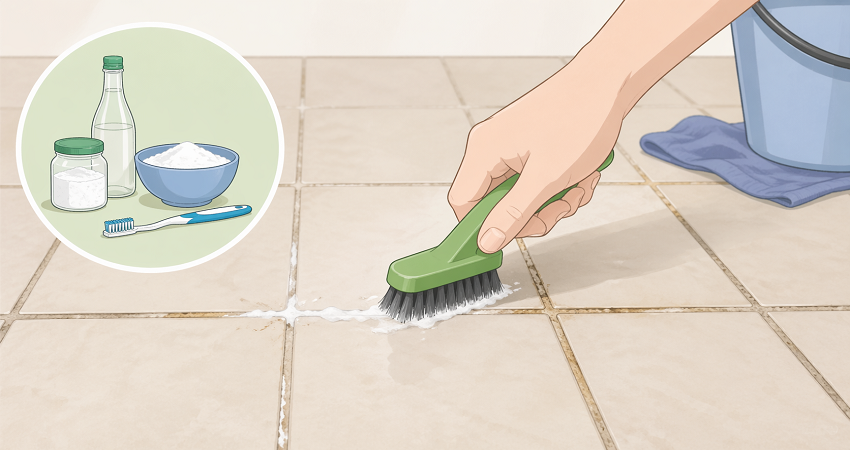
Apply a thick paste of baking soda and water to your grout lines. Spray the white vinegar over the paste. The resulting fizz is the sound of How To Restore Your Kitchen Floors in action. Let this sit for 10 minutes. This “dwell time” allows the bubbles to travel deep into the grout’s pores.
Step C: The Physical Agitation
Scrub in small, circular motions. Avoid metal brushes as they can wear down the grout and cause it to crumble. For homeowners in coastal areas, salt-air can make these stains particularly stubborn; you might find our beach house cleaning tips helpful for dealing with mineral-heavy grime.
2026 Grout Restoration Efficiency Table
| Method | Best For | Estimated Cost |
|---|---|---|
| Baking Soda + Vinegar | General Grease & Dust | $4.00 |
| Hydrogen Peroxide + Soda | Organic Stains (Coffee/Wine) | $3.00 |
| Lemon Juice + Salt | Rust Stains (from metal furniture) | $2.00 |
| Oxygen Bleach Soak | Deeply Embedded Grey Grime | $8.00 |
3. Dealing with Florida “Hard Water” Buildup
If your kitchen floor is near a bathroom or laundry area, you likely have calcium deposits in your grout. To Restore Your Kitchen Floors in this scenario, you must address the mineral buildup.
Vinegar is excellent for this, but for very tough “white crust,” you may need a citric acid solution. We discuss this further in our guide on removing hard water stains from tiles.
4. Eco-Friendly Finishing
Since the kitchen is where you prepare food, avoiding toxic floor cleaners is essential. Using How To Restore Your Kitchen Floors with natural ingredients ensures your home remains safe. This aligns with the growing trend of eco-friendly ways to clean Florida homes.
After whitening, a final rinse with plain warm water is critical to remove any baking soda residue that could leave the floor feeling “chalky.”
- Pro Tip: Once your grout is white and dry, apply a $10 bottle of grout sealer. This “locks” the pores and prevents future spills from soaking in. It is the single best way to ensure you don’t have to repeat this deep-cleaning process for at least another year.
Managing the “Sand Factor” Post-Restoration
The biggest threat to your newly whitened floors is the abrasive nature of Florida sand. Sand acts like sandpaper on grout, creating new holes for dirt to hide in.
To prevent this, consider using a DIY sand-repellent floor spray. This keeps the sand “loose” on the surface of the tile so it can be swept away before it becomes embedded in the grout.
Special Considerations: Large Homes and Renovations
If your kitchen floor is massive (over 1,000 sq. ft.), the DIY method might be physically exhausting. In such cases, or if you are dealing with renovation dust, it might be worth checking the post-construction cleaning cost in Florida.
Professionals use high-pressure steam extractors that can do in minutes what takes hours by hand. For smaller kitchens, however, the hand-scrubbing method is the most precise way to Restore Your Kitchen Floors.
Frequently Asked Questions (FAQ)
1. Is it safe to use bleach on my kitchen grout?
While bleach whitens, it is a harsh base that can actually weaken the structure of the grout over time, leading to cracking. Hydrogen peroxide is a much safer “oxygen bleach” alternative for 2026 home care.
2. Why does my grout turn black again so quickly?
This usually happens because a “soap film” was left behind. Soap is sticky. If you don’t rinse thoroughly after cleaning, the soap attracts new dirt instantly. Always do a final rinse with plain water.
3. Can I use a steam mop to restore my floors?
Steam mops are great for maintenance, but for How To Restore Your Kitchen Floors when they are already deeply stained, steam often just “cooks” the stain into the grout. Use the chemical/manual method first, then use steam for weekly upkeep.
4. My grout is actually colored, not white. Will this fade it?
Yes. Vinegar and baking soda can slightly lighten colored grout. If you have dark grey or brown grout, use a pH-neutral commercial cleaner instead of these DIY whitening agents.
5. How long does the $10 DIY process take?
For an average 150 sq. ft. kitchen, expect to spend about 60 to 90 minutes. It is a great Saturday morning project! For more time-saving tips, see our weekly Florida cleaning checklist.
Conclusion
Learning How To Restore Your Kitchen Floors doesn’t have to be an expensive or daunting task. By utilizing the simple power of household reactions and a little “elbow grease,” you can strip away years of Florida grime and grease.
In 2026, the best home care is often the simplest. A clean, white floor changes the entire energy of your kitchen, making it feel more hygienic and modern instantly.
Whether you choose the $10 DIY route or decide to call in a team for a deep cleaning in Tampa, the goal is the same: a beautiful, healthy home. Don’t let stained grout hide the true potential of your kitchen. Grab your baking soda and get started today—you’ll be amazed at the difference ten dollars can make!
Your Immediate Action Step: Go into your kitchen and find the darkest spot of grout (usually near the stove). Test a small patch with baking soda and vinegar today to see the hidden color of your floor!